

“Vietnam is no longer just a developing country but has become an emerging hub in the global value chain. This is why I always believe that, if Vietnam knows how to utilize its resources and intellect effectively, it can progress much faster than other countries in the region.”
“Vietnam is distinctive in its belief and will for development.”
Could you share your impressions of Vietnam, a country that you have been associated with for over 30 years?
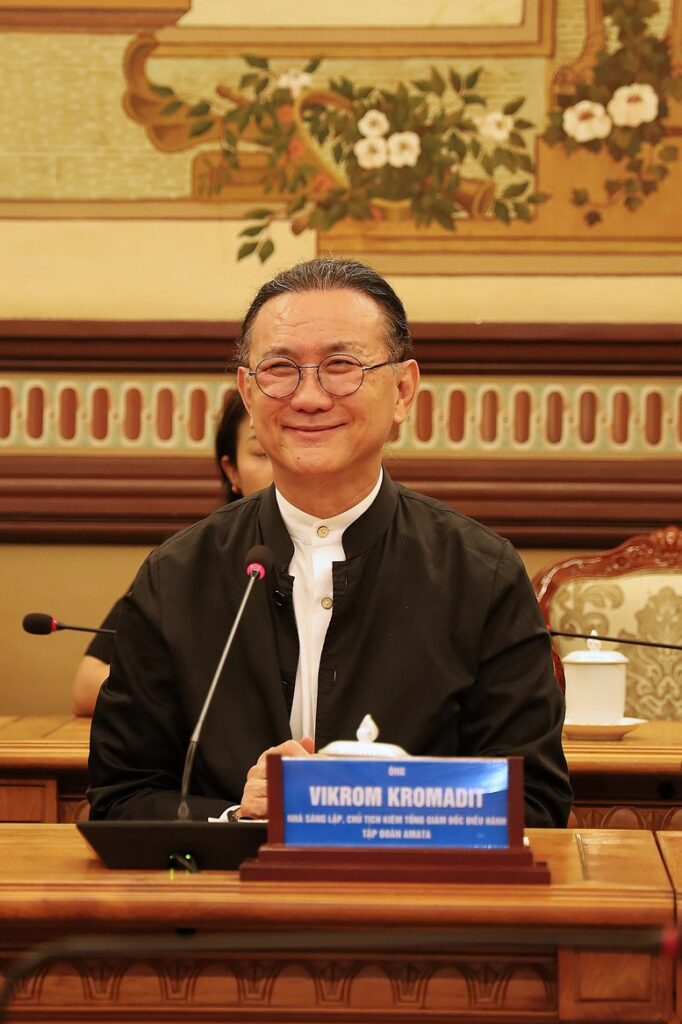
Mr. Vikrom Kromadit: I remember very clearly my first visit to Vietnam in 1991. What impressed me most was not the infrastructure but the people. I sensed a very distinct spirit here: the color red representing belief, energy, and the will to develop.
I am deeply impressed by Vietnam’s unified, clear, and resolute direction towards the future.
And now, Vietnam is no longer just a developing country but has become an emerging hub in the global value chain. This is why I always believe that, if Vietnam knows how to utilize its resources and intellect effectively, it can progress much faster than other countries in the region.
What is your evaluation of Vietnam’s current development?
Mr. Vikrom Kromadit: We all clearly perceive that the Northern region has great potential to become a new industrial-technological center, given a well-planned strategy and enhanced regional linkages.
Meanwhile, the Southern region, especially Ho Chi Minh City (HCMC), is developing very rapidly in finance, technology, and innovation. It possesses clear advantages: a central location, logistics infrastructure, a robust financial-banking system, and notably, a high-quality workforce in R&D.
Looking at Shanghai – a major Asian financial hub – the lesson is clear: they developed their stock exchange, R&D centers, and high-tech zones, creating a tightly integrated financial-industrial-innovation ecosystem. I think HCMC can fully aim for a similar model.
Amata has been present in Vietnam for over 30 years. What will Amata’s strategy be in the next phase?
Mr. Vikrom Kromadit: Over the past 30 years, Amata has participated in building Vietnam’s industrial foundation. Amata’s development strategy for the next phase aligns completely with the Vietnamese Government’s green growth goals, based on three pillars:
First – Green: We are transforming Amata City Bien Hoa Industrial Park into a certified Eco-Industrial Park. The focus is on renewable energy – deploying large-scale rooftop solar power – and the circular economy, such as wastewater recycling aiming for Zero Liquid Discharge.
Second – High-Tech: New projects, especially Amata City Long Thanh, are designed from the outset as “Smart Cities.” We are moving beyond the pure industrial land model to attract electric vehicle (EV) manufacturing, data centers, medical equipment, and R&D centers.
Third – Integrated Logistics: The new regional planning emphasizes the “Golden Triangle” of Long Thanh Airport – Cai Mep Port – HCMC. Our project locations are positioned right at the absolute center of this triangle. We are developing integrated logistics centers right within the industrial parks, providing seamless “factory-to-global-market” connectivity.
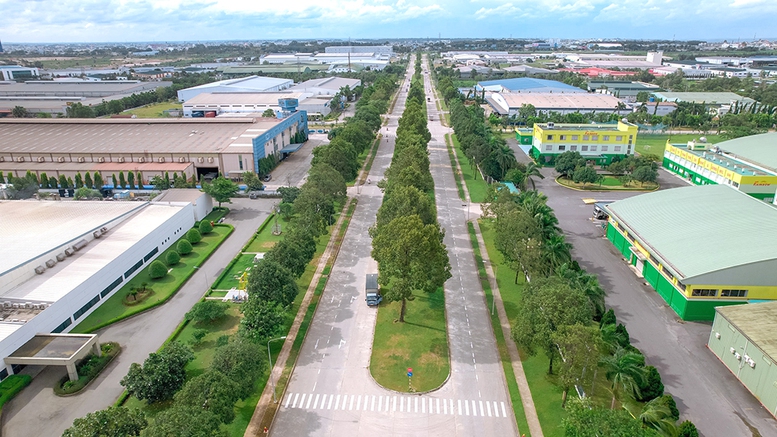
The Amata Corridor: Connecting Dong Nai to the Global Gateway
Besides the two major projects in Dong Nai, does Amata plan to expand to neighboring areas like Ba Ria-Vung Tau or Cai Mep Port?
Mr. Vikrom Kromadit: Amata’s investment strategy is “infrastructure-led” – we go where the strategic transport connections are.
New planning and the focus on Ring Road 3, Ring Road 4, and the Bien Hoa-Vung Tau Expressway are creating a strong economic corridor. The Cai Mep – Thi Vai port cluster is an unmissable factor – this is the gateway to the US and European markets.
Our vision is to create an “Amata Industrial & Logistics Corridor” connecting Dong Nai projects directly to the port ecosystem in Ba Ria-Vung Tau, forming a unified, seamless supply chain for customers.
We are also positioning Amata as a high-tech smart city, especially with its location right next to the new Long Thanh International Airport – a hub for high-value manufacturing and air logistics.
With HCMC expected to become the “coordinating nucleus” for the whole region, how do you perceive the opportunities for linkages in the Southeast region?
Mr. Vikrom Kromadit: I think in this new model, the role of each locality is very clear:
HCMC will excel as the “headquarters” – the center for finance, R&D, innovation, and high-quality human resources.
Dong Nai and Amata function as the “strategic deployment center” – providing the large-scale, high-quality industrial environment that HCMC’s innovations need to scale up.
In that model, our Amata is the bridge. A company can set up its R&D center in Thu Duc City and its advanced manufacturing center at Amata City Long Thanh, just a 30-minute drive apart via the new expressway.
This creates a complete, resilient “From Innovation to Manufacturing” value chain, making the entire Southeast Region more competitive than any other location in ASEAN.
“All Win”: Cooperation for Mutual Development
How will your “All Win” philosophy be reflected in cooperation with HCMC?
Mr. Vikrom Kromadit: “All Win” means our success is directly linked to the success of the local community, particularly the main economic driver – HCMC.
On Innovation & R&D: We fully envision a new generation of projects. We propose cooperation with HCMC’s innovation centers – like Saigon Hi-Tech Park or Thu Duc Creative City – to build satellite R&D and training centers within Amata City Long Thanh. This allows companies to co-locate research and production.
On Green Energy: Amata is already a pioneer in industrial rooftop solar power. We want to partner with HCMC tech and finance companies to develop smart grids and waste-to-energy plants, turning our industrial cities into model sustainable developments.
Future Vision: We are ready to co-develop a “Thai-Viet Green Tech Hub” with HCMC, focusing on the EV ecosystem, smart agriculture technology, and digital innovation – turning the “Comprehensive Strategic Partnership” into concrete, high-value projects.

With decades of experience in industrial and urban infrastructure investment development, what do you think is the most important factor for Vietnam to continue attracting investment?
Mr. Vikrom Kromadit: The most important factors are the quality of infrastructure and energy. A developing region that wants to attract investment must have stable electricity, clean water, good telecommunications, and logistics. If these foundational elements are ensured, we will have “fertile ground” for businesses and investors to develop with long-term peace of mind.
I believe Vietnam can achieve this – with strategic vision and close coordination between the public and private sectors.
We are living in a special time. Vietnam is not just ‘a developing country’ – but an emerging hub in the global value chain now.
Thank you for these insightful sharings!
Source: BAO CHINH PHU